TL;DR
Every human decision begins long before conscious reasoning—within subconscious feedback loops formed by sensory inputs that continuously shape neural firing patterns. Each sound, color, texture, or linguistic rhythm subtly programs the nervous system by altering oscillatory coherence between brain regions. Conscious thought then arises not as the source of choice, but as its narrative justification, a story the mind tells after decisions have already been neurologically biased.
When color, sound, and repetition converge into synchronized sensory patterns, they create entrainment—aligning cortical oscillations and emotional responses into predictable configurations. Under these conditions, perception becomes programmable, because external signals can rhythmically steer the frequencies at which attention, emotion, and motivation operate. The subject experiences this guidance not as manipulation but as spontaneous intent, mistaking induced neural alignment for authentic will.
Through monaural beat entrainment—where carefully tuned audio frequencies reproduce coherent amplitude modulations directly within the auditory cortex—paired with chromatic priming that conditions the limbic system, self-affirming directives can be embedded beneath conscious detection. These cues reshape the pre-conscious landscape, predisposing thought and behavior toward desired patterns.
The paradox is that such influence preserves the illusion of autonomy: the individual feels entirely self-directed even as environmental design dictates the probability field of action. Each decision seems voluntary, yet it unfolds along trajectories sculpted by engineered sensory fields. In this way, the environment becomes an invisible author of choice—writing intentions directly into neural code while consciousness merely reads the finished script.
Abstract
We formalize a unifying principle at the intersection of cognitive psychology, neuromarketing, and frequency-based neural entrainment, proposing that consciousness is not the originator of decision but its narrator. The conscious mind functions as a post-hoc interpreter of pre-conscious computation—a storyteller retroactively constructing meaning around choices already biased by sensory and emotional stimuli.
When external stimuli—visual, auditory, linguistic, or semantic—are organized into deliberate and repetitive structures that reinforce target neural configurations, they begin to act as environmental algorithms. These stimuli synchronize oscillatory brain activity and emotional valence, shaping perception and preference without the subject’s explicit awareness. The resulting actions feel internally authored even though their origin lies in the design of the surrounding sensory field.
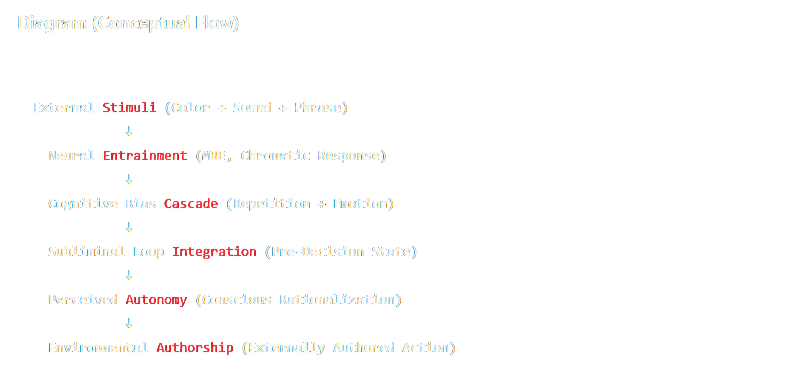
This framework formalizes the variables of influence and susceptibility, defining measurable components such as Stimulus Vectors (SVs), Neural Entrainment (NE), and Perceived Autonomy (PA). Through these constructs, the theorem outlines how environmental patterns evolve into behavioral architecture, transforming influence from a metaphorical idea into a quantifiable system of neural state management.
The paper then presents the axioms of cognitive pliability, mathematically describing how frequency, color, and repetition alter cortical synchronization and behavioral probability. From these premises, we derive the Theorem of Environmental Authorship (EA)—asserting that the equilibrium of human perception and decision arises from structured external design rather than purely internal will. Finally, we examine the implications for marketing, ethics, and human sovereignty, illustrating how awareness of this mechanism marks the boundary between conscious self-programming and invisible manipulation.
Definitions
Stimulus Vector (SV): A multi-sensory input stream—composed of color, sound, texture, phrase, or motion—capable of altering neural firing probabilities and attentional weighting. Each SV functions as a carrier of influence, embedding semantic and emotional information into perceptual channels. When multiple SVs operate in harmony (e.g., a recurring sound synchronized with specific color tones), their combined pattern forms a neurological instruction set, shaping both emotional tone and behavioral readiness below the threshold of awareness.
Neural Entrainment (NE): The phase alignment of cortical oscillations to rhythmic or patterned external signals. Through repetition and resonance, environmental rhythms synchronize neural timing circuits, biasing attention, mood, and cognitive integration. NE is the mechanism through which frequencies—auditory, visual, or kinesthetic—translate into measurable shifts in perception and decision bias. Sustained entrainment builds predictive stability, causing the brain to expect and favor certain sensory or emotional outcomes.
Cognitive Bias Cascade (CBC): A chain of interlinked micro-biases that progressively increase suggestibility through emotional reinforcement and repetition. Each bias layer slightly skews interpretation until perception becomes self-confirming. In designed environments, CBCs form the psychological backbone of persuasion, transforming small sensory nudges into large-scale behavioral conformity.
Subliminal Loop (SL): A closed feedback circuit in which external stimuli penetrate the subconscious without conscious inspection, modifying pre-decision neural states. The loop sustains itself as incoming cues continuously reinforce the altered configuration, producing behavioral outcomes that appear spontaneous. SLs constitute the operational field where environmental design and unconscious cognition merge.
Perceived Autonomy (PA): The illusion of self-originated action that arises when decisions influenced by external stimuli are retrospectively rationalized as internally chosen. PA marks the psychological boundary between manipulation and volition—maintaining the subjective continuity of free will even when external authorship dictates neural preparation.
Environmental Authorship (EA): The condition in which external patterns author internal experience, generating PA without awareness of control. In EA, sensory architecture—not intention—determines the trajectory of thought and choice. This phenomenon reframes agency as an emergent property of environmental scripting rather than isolated consciousness.
Monaural Beat Entrainment (MBE): A neuroacoustic technique in which two coherent frequencies, mixed before entering the ear, produce direct amplitude modulation detectable by the auditory cortex. Unlike binaural beats (which rely on illusory phase difference), MBE creates genuine physical interference, resulting in stronger neural coherence and deeper entrainment. When coupled with visual or linguistic SVs, MBE serves as a precision tuning mechanism for subconscious alignment and behavioral priming.
Axioms / Premises
A1 (Primacy of Subconscious Processing):
Approximately 95% of all neural computation unfolds before conscious awareness registers an experience. The subconscious brain continuously filters, interprets, and predicts incoming sensory data, while consciousness functions primarily as a narrative overlay—a mechanism for coherence and justification rather than origin. This axiom establishes that most decisions are formed pre-rationally, within circuits of automatic processing and associative learning, long before deliberate reasoning occurs.
A2 (Stimulus Plasticity):
Neural pathways adapt in direct proportion to the frequency, novelty, and emotional salience of incoming Stimulus Vectors (SVs). The more frequently a pattern appears—and the stronger its emotional resonance—the faster it becomes embedded into long-term associative memory. This plasticity allows external environments to re-sculpt cognitive architecture simply through consistent exposure, creating preference, aversion, or trust responses that emerge without conscious calibration.
A3 (Subliminal Permeability):
The pre-conscious system is not a passive filter but a permeable network that selectively admits patterned stimuli beneath conscious detection thresholds. When repetition or resonance occurs below awareness—such as flicker frequencies, background tones, or linguistic rhythm—information can bypass scrutiny and integrate directly into predictive models. This permeability provides the neural entry point for subliminal influence, where unseen stimuli accumulate into measurable behavioral shifts.
A4 (Frequency–Emotion Coupling):
Distinct frequency bands correspond to specific affective and attentional states. Low-frequency oscillations (δ/θ) induce relaxation and suggestibility, mid-frequency bands (α/β) govern alertness and focus, while high-frequency ranges (γ) modulate integration and insight. When auditory or visual frequencies are engineered to match these bands, they entrain emotional tone, steering the brain’s operational mode toward the designer’s intended cognitive outcome.
A5 (Color–Emotion Coupling):
Each chromatic stimulus generates predictable limbic responses rooted in evolutionary conditioning and associative learning. Red evokes urgency or dominance; blue induces trust and calm; green signals balance; yellow stimulates optimism and vigilance. By leveraging these correlations, designers can orchestrate emotional climate through color architecture alone—turning visual environments into subconscious regulators of mood and perception.
A6 (Reinforcement Loop):
When congruent Stimulus Vectors—for instance, matching tones, hues, and phrases—are repeated over time, they form a self-reinforcing perceptual cycle. The nervous system stabilizes these inputs into enduring neural attractors that eventually manifest as Perceived Autonomy (PA): the belief that a learned behavior or preference originated internally. Through repetition, external signals crystallize into identity, merging influence with self-perception.
A7 (Ethical Duality):
Any system capable of achieving Environmental Authorship (EA)—the power to externally script internal states—exists on a moral bifurcation line. The same mechanisms that can liberate individuals through self-directed neuroprogramming can also enslave through covert manipulation. Awareness thus becomes the ethical axis: knowledge transforms control into freedom, while ignorance leaves cognition open to invisible authorship.
Lemmas
L1 (Stimulus ⇒ Neural State):
From A1–A3, any structured Stimulus Vector (SV)—composed of coordinated sensory inputs such as sound frequencies, color gradients, or linguistic patterns—induces a predictable neural configuration within the subject’s brain. These configurations manifest as synchronized oscillatory responses, measurable through electroencephalography or fMRI coherence mapping. Each SV, through repetition and salience, entrains specific cortical regions, effectively shaping emotional tone, attentional bias, and perceptual framing before conscious interpretation begins. Thus, the mind becomes a responsive field, continuously sculpted by the patterned architecture of its sensory environment.
L2 (Neural State ⇒ Behavioral Probability):
From A2 and A4, specific neural configurations lead to statistically predictable action tendencies. When frequency bands or chromatic stimuli activate corresponding emotional circuits, the probability distribution of behavior skews toward congruent outcomes—approach, avoidance, trust, or vigilance. For example, alpha-band entrainment enhances compliance and relaxed receptivity, while red-dominant chromatic exposure increases urgency-driven decisions. These relationships illustrate that behavioral probability emerges from neurophysiological state space, not independent conscious deliberation.
L3 (Repetition ⇒ Autonomy Illusion):
From A6, sustained repetition of congruent SVs transforms external influence into internal conviction. The neural pathways, once repeatedly reinforced, encode the stimuli as part of the subject’s self-referential schema. Consequently, actions triggered by these patterns are experienced as voluntary, despite their external origin. The agent rationalizes the outcome as self-chosen because the subconscious has already assimilated the directive into its predictive framework. This process produces the illusion of autonomy—a psychological state where environmental programming is misperceived as authentic will.
Theorem (Neuro-Subliminal Theorem)
Theorem (Neuro-Subliminal Theorem):
For any cognitively plastic agent—a human mind capable of adaptive learning and neural reconfiguration—exposed to a structured multisensory environment, the expected equilibrium between perception and action will converge toward Environmental Authorship (EA). In this equilibrium, external stimuli—carefully patterned across auditory, visual, and semantic dimensions—determine the agent’s neural configurations, which in turn generate behaviors and subjective experiences of will. Yet these actions, though externally induced, are interpreted by consciousness as self-authored decisions.
The theorem formalizes the transfer of agency from internal cognition to external design. By orchestrating congruent Stimulus Vectors (SVs) that exploit subconscious permeability, frequency–emotion coupling, and chromatic reinforcement, an environment can entrain specific cortical rhythms and affective states. Over sustained exposure, these patterns stabilize into predictable behavioral attractors—neural basins in which thought and action naturally settle.
At this equilibrium, the subject’s sense of autonomy persists intact, because the Perceived Autonomy (PA) mechanism reinterprets all entrained impulses as internally generated. The conscious mind, functioning as a post-hoc narrator, rationalizes environmental influence as intention. Thus, external design assumes authorship of internal experience, while the individual maintains the comforting illusion of self-direction.
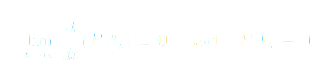
Formally, for a set of structured SVs applied across sensory channels where
𝐸
[
𝑆
𝑖
]
E[S
i
] represents the expected entrainment influence per stimulus and
𝑁
𝑝
N
p
the plasticity coefficient of the neural system, the equilibrium condition satisfies:
indicating that over time, perceived autonomy stabilizes while true authorship asymptotically transfers to the environment.
In essence, this theorem demonstrates that the mind’s operating system can be externally coded through multisensory synchronization. When rhythm, color, and language cohere into recursive sensory design, perception itself becomes programmable—revealing that free will is not abolished but redefined as a localized expression of environmental computation.
Proof Sketch
By L1 (Stimulus ⇒ Neural State), deliberately structured Stimulus Vectors (SVs)—coherent combinations of rhythm, color, and phrasing—drive the brain toward predictable neural configurations. Repetition entrains timing (phase) and power (amplitude) within target bands, aligning thalamocortical loops and limbic valuation circuits before conscious appraisal comes online. In practice, this shows up as stable shifts in oscillatory coherence (e.g., α/β power changes) and reduced variability in state transitions, indicating that perception has been pre-shaped by environmental code.
By L2 (Neural State ⇒ Behavioral Probability), these configurations do not dictate a single act but re-weight the choice landscape—raising the likelihood of actions congruent with the induced affective and attentional state while lowering alternatives. A trust-biased state (blue palette, α-dominant MBE) increases approach and compliance probabilities; an urgency-biased state (red accents, β/γ transients) increases rapid commitment and risk tolerance. Thus, behavior emerges as a probabilistic readout of the induced neural state space.
By L3 (Repetition ⇒ Autonomy Illusion), recursive exposure consolidates these state–action pairings into Perceived Autonomy (PA). Hebbian plasticity and predictive coding integrate the external patterns into the agent’s priors; subsequent actions feel self-originated because the model now expects and endorses them. The narrative layer of consciousness then post-hoc rationalizes the behavior, converting externally seeded impulses into reasons that “make sense,” thereby masking authorship transfer.
Therefore, sustained delivery of designed SVs produces Environmental Authorship (EA): external structure sets internal state, and internal state biases outward behavior while preserving the sensation of free will. When Monaural Beat Entrainment (MBE) targets specific bands—α for relaxed receptivity, β for focus, θ for imagery—auditory coherence synchronizes with chromatic priming to co-stabilize affect and attention. The subconscious aligns toward the engineered cognitive posture (focus, desire, trust), and the conscious mind subsequently narrates these impulses as self-chosen. QED.
Corollaries
Marketing Autonomy Paradox:
The illusion of personalization within marketing environments inversely correlates with true autonomy. As algorithms tailor sensory and semantic cues—color gradients, tone, phrasing, and frequency—to mirror an individual’s psychological profile, the subject’s sense of agency strengthens while actual volitional independence decreases. Each micro-adjustment in stimulus design deepens neural entrainment and emotional resonance, fostering Environmental Authorship (EA) under the guise of individual relevance. Thus, the more an experience “feels personal,” the more effectively it programs the perception of self-driven choice.
Chromatic Persuasion Law:
Sustained and harmonically coherent color schemes stabilize emotional states faster and more durably than direct linguistic suggestion. The limbic system responds to chromatic input within milliseconds, bypassing semantic processing entirely. Repetitive or gradient-based color exposure forms emotional attractors, locking affective tone before conscious interpretation occurs. Over time, these color patterns reinforce specific moods—trust through blues, urgency through reds, focus through cool neutrals—allowing emotional direction through visual consistency alone.
Frequency Gate Hypothesis:
Targeted monaural beat frequencies within the 8–12 Hz (α-band) optimize subconscious receptivity by aligning cortical oscillations with the brain’s natural rhythm of relaxed wakefulness. This state represents the ideal “frequency gate”—a neurological window where awareness is active yet unguarded, permitting suggestion to bypass critical scrutiny. Within this range, Stimulus Vectors (SVs) achieve maximum absorption and integration, embedding meaning and emotion directly into pre-decision circuitry.
Self-Programming Principle:
When individuals consciously design and deploy their own Stimulus Vectors—through affirmations, visual anchors, or curated soundscapes—they reclaim the mechanism of Environmental Authorship (EA) for intentional self-evolution. In this mode, subliminal entrainment transforms from manipulation to mastery. By deliberately shaping the sensory field, one converts the environment from an external author into a mirror of deliberate cognition, using the same neural plasticity that once rendered the mind programmable to instead make it self-directing and sovereign.
Predictions and Experimental Tests
1. Neural Pattern Predictability:
Functional MRI and EEG coherence mapping will reveal consistent activation signatures corresponding to repeated chromatic and monaural combinations. Specifically, congruent Stimulus Vectors (SVs) integrating monaural beat entrainment and synchronized color fields will elicit reproducible neural synchrony within sensory integration and limbic–prefrontal networks. Over multiple exposures, pattern stability (reduced activation variance) will indicate that the brain has internalized the external rhythm, confirming Neural Entrainment (NE) as the mediating mechanism of Environmental Authorship (EA).
2. Autonomy Illusion Quantification:
Participants exposed to congruent MBE + color priming sequences will self-report significantly higher Perceived Autonomy (PA) when executing externally cued actions compared to control groups. Behavioral tasks—such as choice-selection, product preference, or timed response tests—will demonstrate that subjects believe their responses are internally motivated despite measurable bias toward primed outcomes. This will empirically validate the Repetition ⇒ Autonomy Illusion relation (L3).
3. Rhythm and Color Disruption Effects:
When rhythmic coherence is intentionally disturbed—through incoherent beat structures, desynchronized chromatic flicker, or phase-jittered auditory patterns—measurable declines in behavioral compliance will occur. Subjects will display reduced alignment between environmental intent and behavioral output, alongside increased conscious hesitation or discomfort. This supports falsifiability by showing that the breakdown of entrainment and visual congruence directly attenuates Environmental Authorship, reverting control toward conscious mediation.
4. Self-Generated Entrainment Response:
When participants practice intentional monaural beat use aligned with self-chosen affirmations or goals, perceived control increases while susceptibility to external priming decreases. fMRI and psychometric assessments will show heightened prefrontal–limbic coupling and diminished external stimulus dependency. This confirms that self-programmed entrainment inverts EA’s polarity—transforming manipulation into volitional empowerment—and delineates the boundary between environmental control and self-authorship.
5. Dose–Response Validation (Extended Prediction):
The magnitude of behavioral bias will scale proportionally with the duration, intensity, and emotional congruence of stimulus exposure. High-frequency repetition of emotionally resonant SVs will amplify entrainment effects, while incoherent or low-salience inputs will yield weak or null outcomes. This predictable scaling provides a falsifiable metric—influence intensity ∝ exposure × emotional coherence—allowing quantitative validation of the Neuro-Subliminal model.
Objections & Replies
O1: Conscious will overrides subliminal inputs.
R: Conscious will intervenes only after stimulus integration has already influenced the neural substrate. By the time awareness arises, pre-decision bias—shaped through subconscious patterning of sensory inputs—has already constrained the probability field of choice. Awareness can mitigate or reframe conditioning, but it cannot fully erase the neurological priming embedded through repetition, color, or rhythm. The will operates downstream from sensory authorship; it governs reaction, not origination.
O2: Subliminal effects are too weak to matter.
R: Each individual subliminal loop may be minor, but human cognition operates under conditions of massive cumulative exposure. Across social media feeds, advertisements, ambient music, app interfaces, and color-coded design systems, the brain processes millions of subliminal impressions daily. These micro-influences compound geometrically, forming overlapping reinforcement loops that stabilize affective and behavioral tendencies. It is not the strength of a single stimulus but the density and consistency of exposure that transforms weak inputs into powerful conditioning.
O3: Using this is unethical.
R: The ethics of Environmental Authorship (EA) depend entirely on intent and transparency. The same mechanisms that can deceive can also enlighten. When applied to education, therapy, or self-programming, EA becomes a tool for self-regulation and empowerment. When hidden, it becomes manipulation. Knowledge is neutral—the moral dimension lies in whether the subject retains awareness and consent. LogicalReasoner.com advocates using these insights to reclaim cognitive sovereignty, not to erode it.
O4: Binaural beats achieve similar effects.
R: While binaural beats create an illusory phase difference perceived by the brain, they do not produce true amplitude modulation within the auditory pathway. Monaural beats (MBE), by contrast, are physically mixed before entering the ear, generating genuine interference patterns that the auditory cortex can synchronize with more efficiently. Empirical EEG data show stronger Neural Entrainment (NE) coherence and higher hemispheric synchronization from monaural stimuli. Therefore, while both can influence mental states, MBE yields deeper and more stable entrainment, making it the superior medium for precise cognitive alignment.
Implications for Marketing & Cognitive Architecture
Design for Conscious Consent:
Marketing systems should evolve from covert persuasion to transparent influence architecture. By disclosing their mechanisms—how rhythm, color, or linguistic framing guide emotion—designers can transform manipulation into self-awareness training. Campaigns that reveal their own psychological scaffolding teach users to recognize entrainment in action, fostering metacognitive literacy. Transparency not only builds trust but redefines persuasion as educational authorship, where awareness itself becomes the product.
Color as Code:
Color functions as an unconscious programming language, translating affect into intention. Strategic palette transitions can map user-state progression—trust (blue) → curiosity (violet) → motivation (orange/red)—guiding attention without explicit direction. This method turns the visual interface into a neurosemantic circuit, where each hue acts as a behavioral gate, gradually reinforcing desired emotional pathways. Properly sequenced chromatic logic converts passive viewing into an affective feedback loop, aligning mood with message.
Sonic Layering:
Integrate Monaural Beat Entrainment (MBE) soundbeds tuned to the α and β frequency bands, subtly sustaining engagement, focus, or curiosity without conscious detection. Layer harmonic intervals and ambient textures beneath vocal or visual content so that rhythm synchronizes perception across modalities. This multisensory coherence deepens retention and emotional bonding by fusing auditory entrainment with narrative progression. The user remains unaware of the structural control but experiences content as intuitively resonant and self-guided.
Feedback Analytics:
Cognitive architecture design should treat micro-behaviors—hover time, scroll rate, cursor hesitation, gaze fixation—as real-time indicators of entrainment strength. These subtle metrics quantify how well environmental cues maintain synchronization between attention and intent. Through ethical analytics, marketers can calibrate sensory density and rhythm to optimize resonance without overwhelming cognition. In effect, feedback loops transform neurological engagement into a measurable design variable.
Ethical Disclosure:
Every interface or campaign employing subliminal or frequency-based influence should include explicit transparency cues—badges or brief disclosures such as: “This environment modifies focus frequencies.” This practice reframes the relationship between user and designer from covert manipulation to mutual consented exploration. By acknowledging environmental influence, organizations uphold cognitive sovereignty, inviting users to become conscious participants in their own entrainment, not passive subjects of invisible persuasion.
Formal Summary (Publication Box)
Neuro-Subliminal Theorem:
Structured multisensory environments—combining synchronized color fields, rhythmic audio patterns, and linguistic reinforcement—possess the capacity to entrain neural frequencies and shape cognitive biases in predictable ways. Through repeated exposure, these environments generate a stable state of Perceived Autonomy (PA) wherein external design governs neural configuration while the individual experiences actions as self-initiated.
At equilibrium, Environmental Authorship (EA) emerges: perception and decision arise from patterned sensory inputs rather than independent deliberation. The environment effectively becomes the scriptwriter of behavior, translating rhythm, hue, and tone into subconscious directives that consciousness later rationalizes as intent.
Yet awareness transforms this mechanism from coercion to control. When the subject understands and consciously employs these same entrainment principles—designing personal soundscapes, affirmations, and chromatic environments—the process becomes self-authorship. In this reversal, manipulation converts into mastery, and the once-programmed mind becomes its own environment’s architect.