Introduction
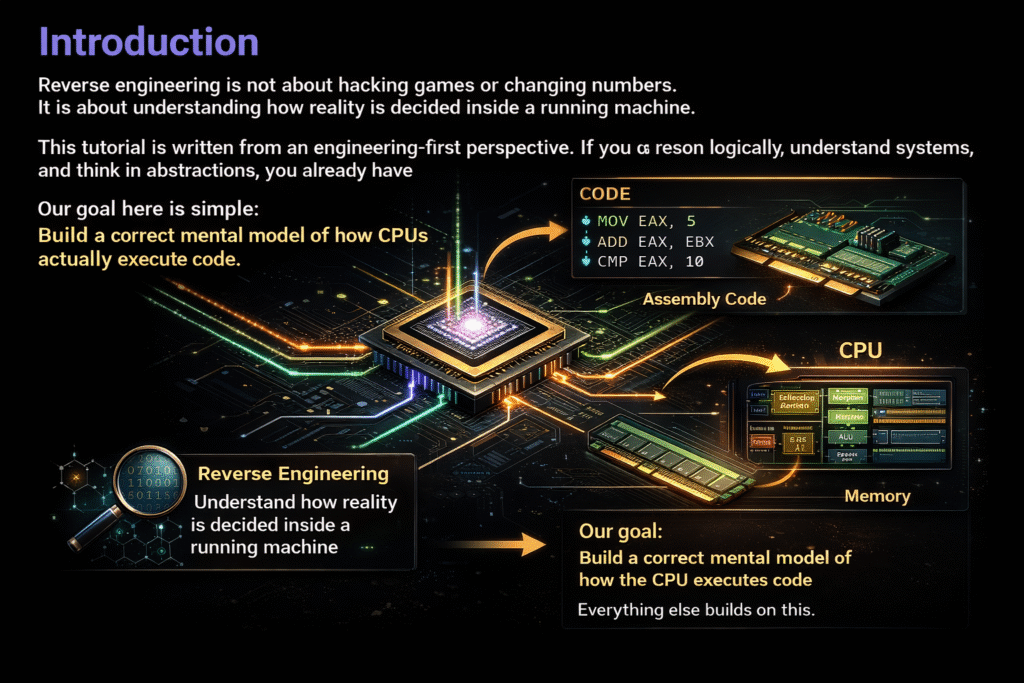
Reverse engineering is not about hacking games or changing numbers.
It is about understanding how reality is decided inside a running machine.
This tutorial is written from an engineering-first perspective. If you can reason logically, understand systems, and think in abstractions, you already have what most people lack.
Our goal here is simple:
Build a correct mental model of how CPUs actually execute code.
Everything else builds on this.
What a Register Actually Is
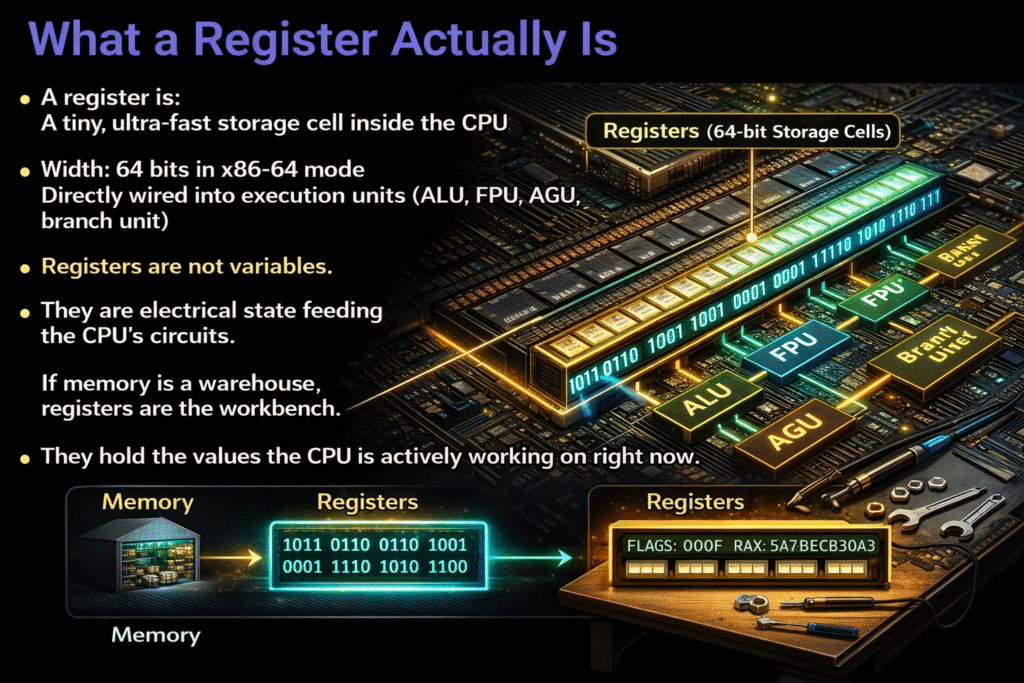
A register is:
A tiny, ultra-fast storage cell inside the CPU
Width: 64 bits in x86-64 mode
Directly wired into execution units (ALU, FPU, AGU, branch unit)
Registers are not variables.
They are electrical state feeding the CPU’s circuits.
If memory is a warehouse, registers are the workbench.
They hold the values the CPU is actively working on right now.
The Architectural Register Set (x86-64)
In 64-bit mode, the general-purpose registers are:
RAX, RBX, RCX, RDX
RSI, RDI
RBP, RSP
R8–R15
RIP (special)
Each register has historical bias, not strict rules.
The CPU does not care about “purpose”. The ABI (Application Binary Interface) does.
The ABI is a contract between functions. Breaking the contract causes crashes.
RAX – The Accumulator
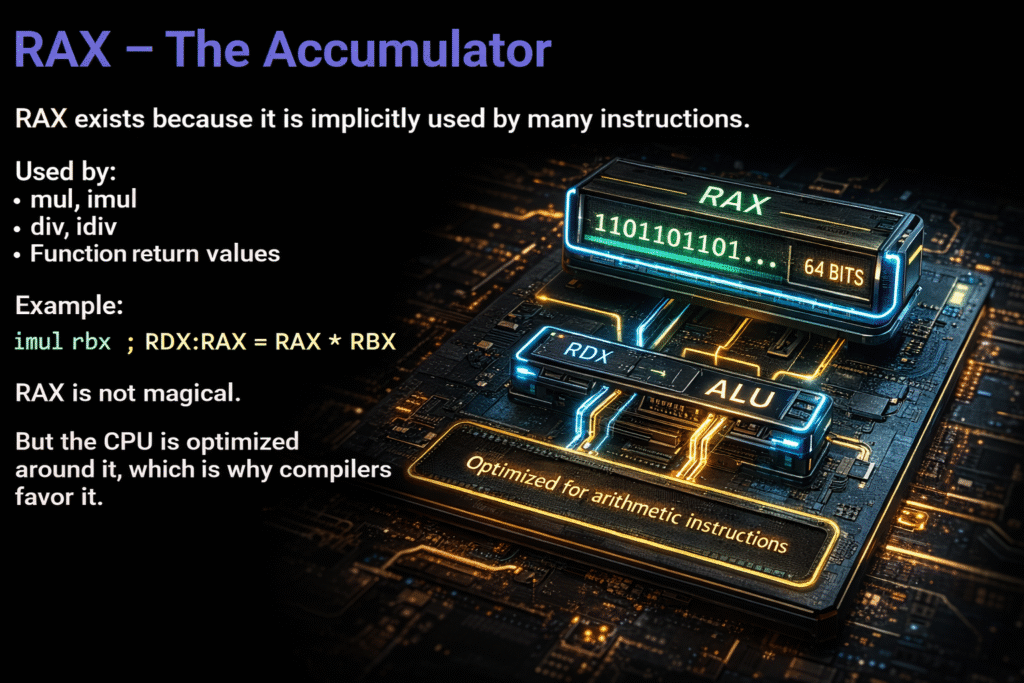
RAX exists because it is implicitly used by many instructions.
Used by:
mul, imul
div, idiv
Function return values
Example:
imul rbx ; RDX:RAX = RAX * RBX
RAX is not magical.
But the CPU is optimized around it, which is why compilers favor it.
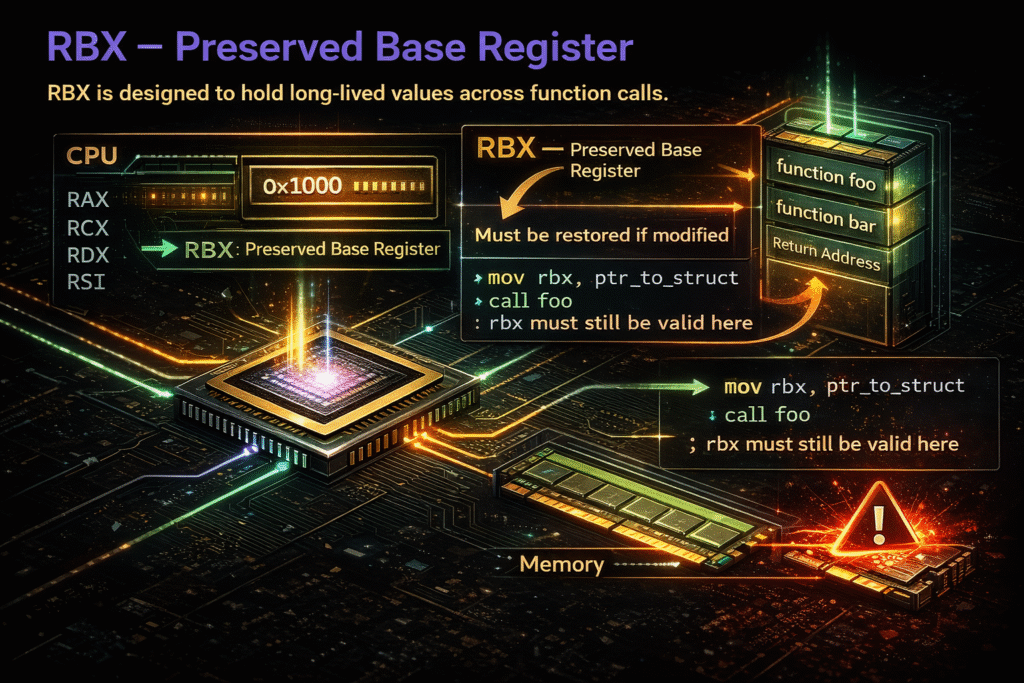
RBX – Preserved Base Register
RBX is designed to hold long-lived values across function calls.
The ABI rule:
If a function modifies RBX, it must restore it before returning.
Example:
mov rbx, ptr_to_struct
call foo
; rbx must still be valid here
If foo destroys RBX, the caller is corrupted.
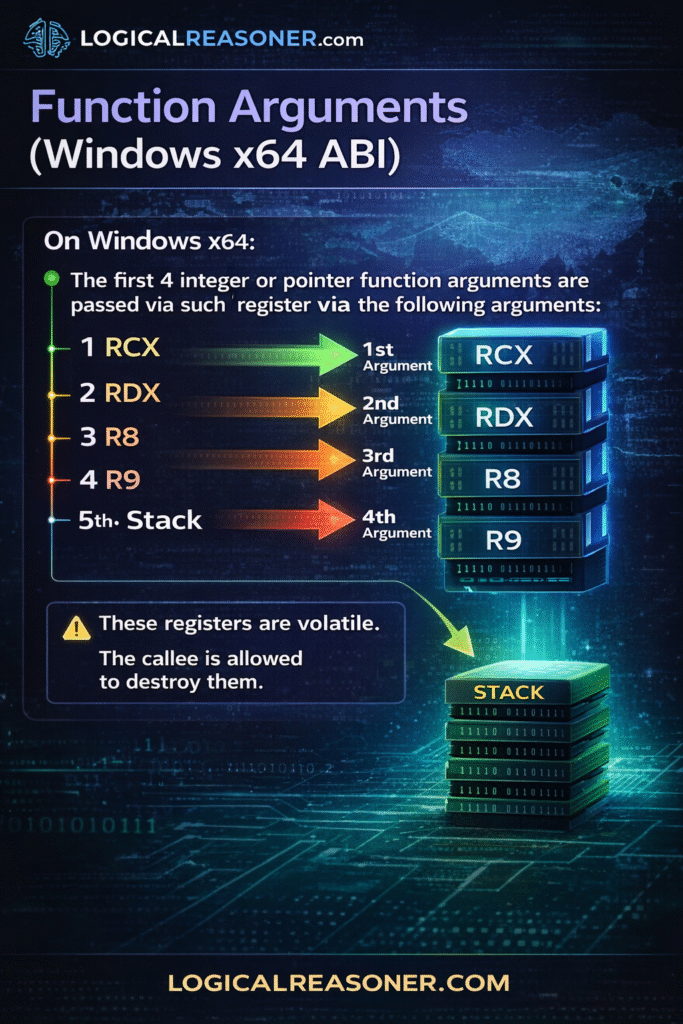
Function Arguments (Windows x64 ABI)
On Windows x64:
Argument Register
1 RCX
2 RDX
3 R8
4 R9
5+ Stack
These registers are volatile.
The callee is allowed to destroy them.
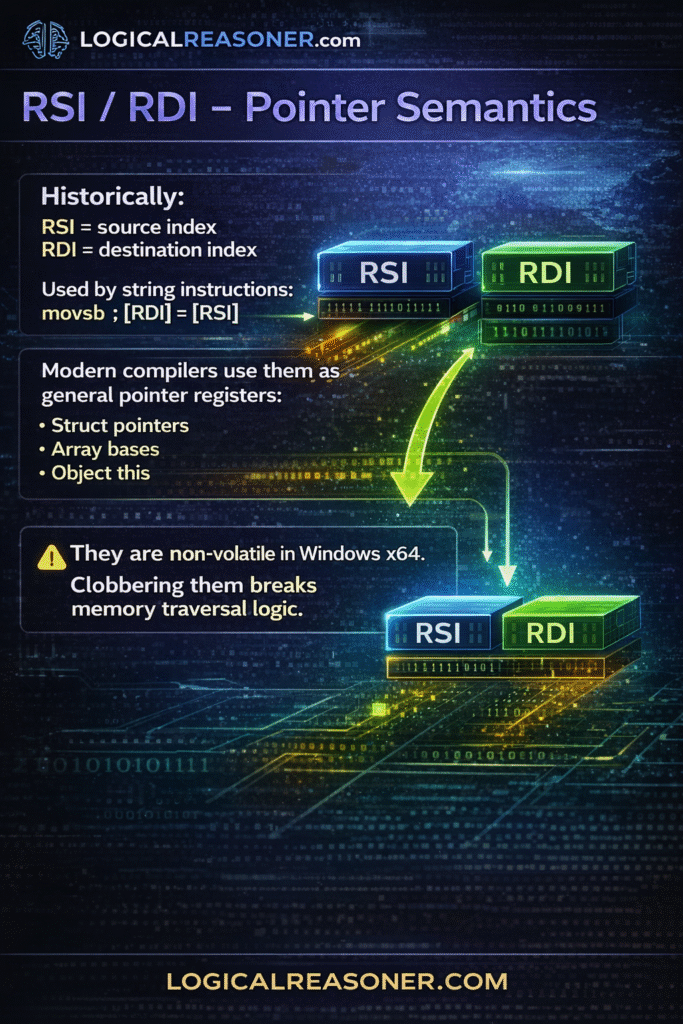
RSI / RDI – Pointer Semantics
Historically:
RSI = source index
RDI = destination index
Used by string instructions:
movsb ; [RDI] = [RSI]
Modern compilers use them as general pointer registers:
Struct pointers
Array bases
Object this
They are non-volatile in Windows x64.
Clobbering them breaks memory traversal logic.
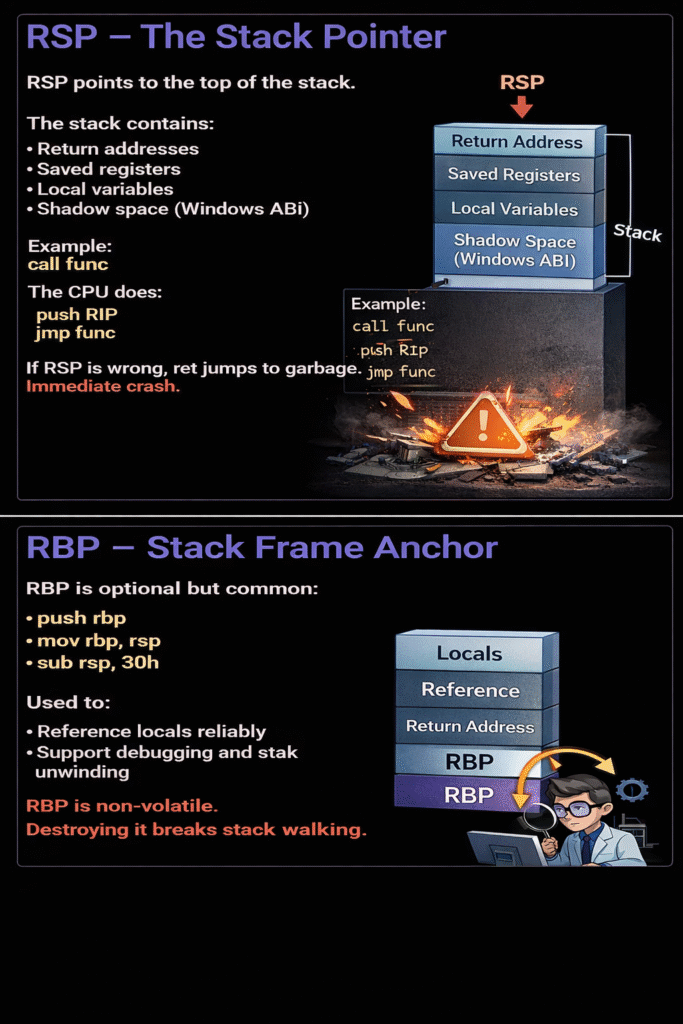
RSP – The Stack Pointer
RSP points to the top of the stack.
The stack contains:
Return addresses
Saved registers
Local variables
Shadow space (Windows ABI)
Example:
call func
The CPU does:
push RIP
jmp func
If RSP is wrong, ret jumps to garbage.
Immediate crash.
RBP – Stack Frame Anchor
RBP is optional but common:
push rbp
mov rbp, rsp
sub rsp, 30h
Used to:
Reference locals reliably
Support debugging and stack unwinding
RBP is non-volatile. Destroying it breaks stack walking.
RIP – Instruction Pointer
RIP points to the next instruction.
You cannot write to it directly.
It changes only via:
jmp
call
ret
Conditional branches
Exceptions
This is why hooks work:
jmp newmem
You hijack control flow.
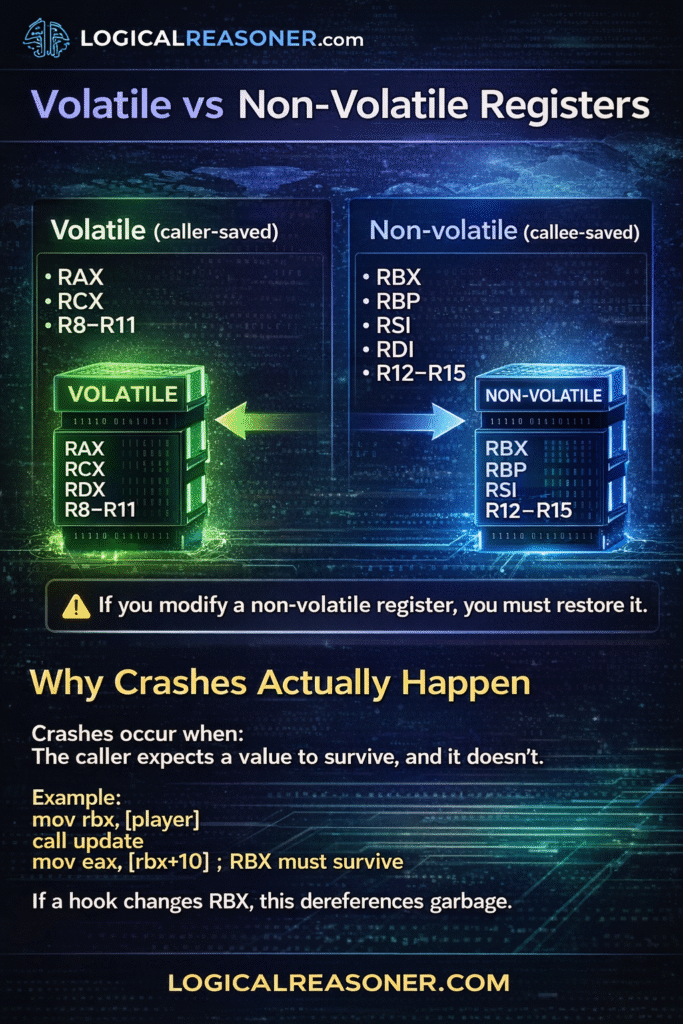
Volatile vs Non-Volatile Registers
Volatile (caller-saved)
RAX
RCX
RDX
R8–R11
Non-volatile (callee-saved)
RBX
RBP
RSI
RDI
R12–R15
If you modify a non-volatile register, you must restore it.
Why Crashes Actually Happen
Crashes occur when:
The caller expects a value to survive, and it doesn’t.
Example:
mov rbx, [player]
call update
mov eax, [rbx+10] ; RBX must survive
If a hook changes RBX, this dereferences garbage.
The Real Mental Model
Think like this:
Registers are shared state
ABI is a contract
Crashes are contract violations
Reverse engineering means:
Identifying which parts of the contract are active at a given instruction
What an Opcode Is
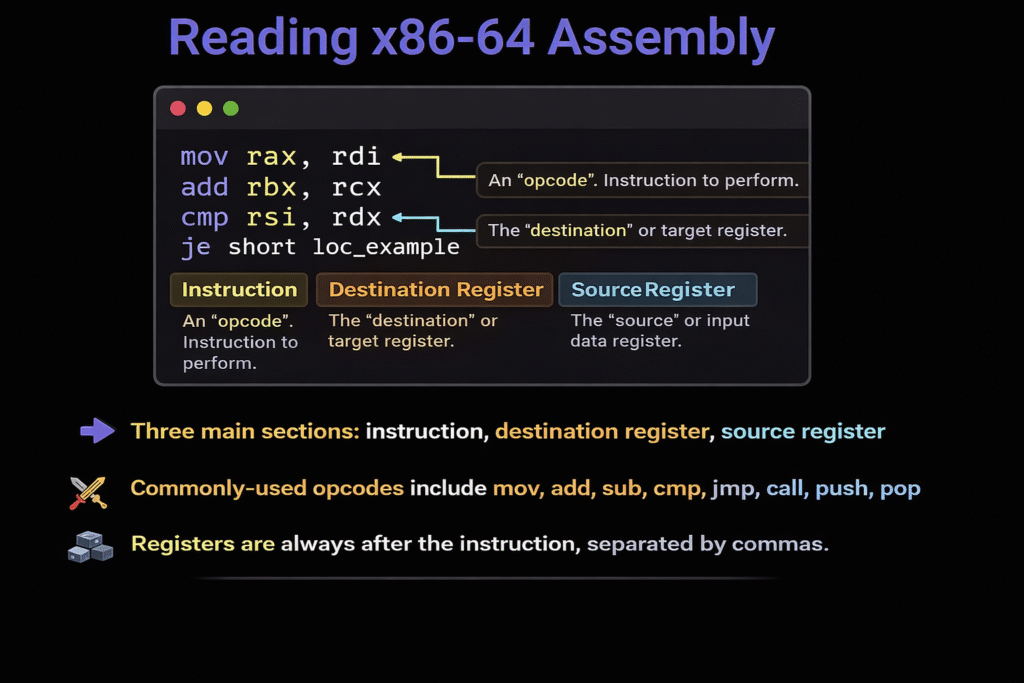
An opcode is the byte-level command the CPU decodes to perform an operation.
Example:
mov eax, ebx
The CPU actually sees:
89 D8
89 → opcode (move r/m32, r32)
D8 → ModR/M byte (register encoding)
Assembly mnemonics are human labels. Opcodes are truth.
Instruction Encoding
An x86-64 instruction can be:
[Prefix][REX][Opcode][ModRM][SIB][Displacement][Immediate]
Example:
mov rax, rbx
Encoded as:
48 89 D8
Hooks overwrite bytes, not instructions. AOB scans depend on byte stability.
Opcode Families (How to Learn Efficiently)
You do not memorize thousands of opcodes.
You learn families.
Data Movement
mov, movsx, movzx, xchg, lea, push, pop
Arithmetic
add, sub, imul, mul, inc, dec, neg
Logic
and, or, xor, shl, shr, sar
Control Flow
jmp, je, jne, call, ret
Floating Point (SSE)
movss, addss, mulss, divss
Recognition matters more than memorization.
Final Principle
You stop thinking:
“This is a mov instruction.”
You start thinking:
“This byte pattern transfers ownership of state.”
That shift is the beginning of real reverse engineering.