Abstract
While binaural beats rely on the perceptual illusion of phase-differential frequency interpretation within the auditory cortex, monaural beats operate through direct acoustic interference — creating a true physical oscillation in the air before reaching the ear. Unlike binaural beats, which depend on the brain's interpretive mechanisms to perceive a difference between two slightly offset frequencies, monaural beats generate a tangible interference pattern in the auditory signal itself, meaning the oscillatory energy is present in the acoustic waveform prior to cortical processing.
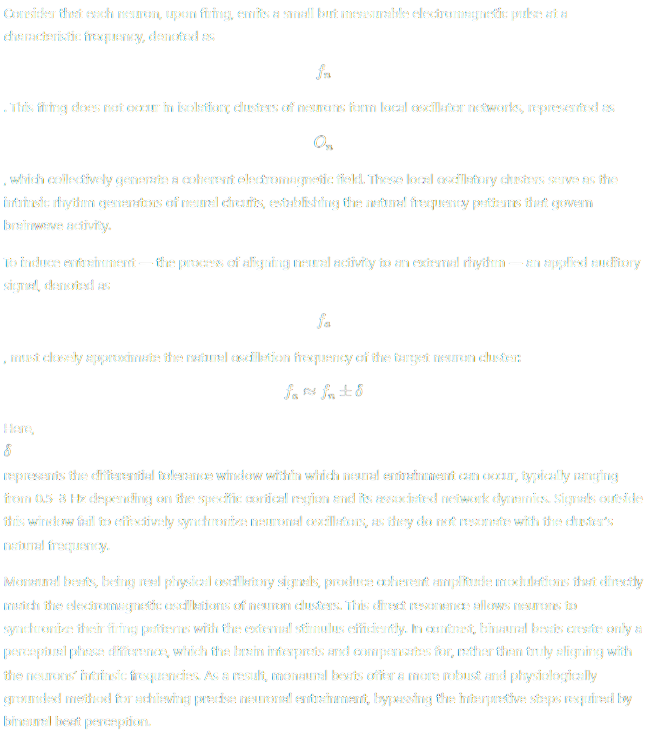
This theorem proposes that monaural beats are superior in neuronal entrainment because they target the electromagnetic oscillators produced by neural firing rather than relying on perceptual reconstruction. By directly engaging the inherent electromagnetic oscillations of neural clusters, monaural beats can achieve a higher degree of coherence between external auditory stimuli and intrinsic neuronal activity, potentially leading to more robust synchronization of neural networks. This direct resonance bypasses the brain’s interpretive layer, allowing for a purer form of entrainment that aligns physical acoustic phenomena with neuronal oscillatory dynamics.
Monaural beats, therefore, do not merely create an auditory illusion but induce measurable oscillatory effects in the neural circuits themselves. This direct engagement allows for a more precise modulation of brainwave frequencies, enhancing the effectiveness of neuroacoustic interventions in applications such as cognitive enhancement, relaxation, meditation, and therapeutic modulation of mental states. The implications suggest a paradigm shift in understanding auditory stimulation — from perception-based effects to physically grounded neuronal resonance.
By focusing on the interaction between true acoustic interference and neuronal electromagnetic activity, the Monaural Oscillation Resonance Theorem establishes a scientific framework for designing auditory stimuli that optimize entrainment efficacy. This approach opens the door to controlled manipulation of neural oscillations with unprecedented precision, offering a foundation for both experimental neuroscience and applied neurotechnology.
Core Principle
Binaural beats are fundamentally an illusory phenomenon: they arise from a signal difference that exists only in the phase relationship between two tones delivered separately to each ear. The brain detects this discrepancy and interprets it as a beat frequency, creating the perception of a rhythm that is not physically present in the external sound. This means that binaural beats rely entirely on cortical processing and the brain’s ability to reconstruct a frequency difference internally, rather than on any direct physical oscillation impacting the neural tissue.
In contrast, monaural beats involve the actual superposition of two close frequencies in the same acoustic signal before it reaches the ears. This creates real interference patterns in the air, which both ears perceive identically. Because the oscillatory pattern exists in the physical waveform itself, it directly interacts with the auditory system in a consistent and measurable way. The resulting neural activity is not a product of interpretive perception, but a response to true oscillatory energy that can entrain neurons through direct resonance.
Thus, the neural effect of monaural beats is fundamentally physical. Neurons respond to the amplitude modulations of these real oscillations in a manner that aligns with their natural firing frequencies. Unlike binaural beats, where the brain must infer a beat, monaural beats impose a tangible rhythmic stimulus, producing a more reliable and immediate synchronization of neuronal oscillators. This establishes monaural beats as a direct tool for influencing neural activity, independent of cognitive interpretation.
The Resonance Hypothesis
Dual-Monaural Interference Model
The 3D Placement Principle
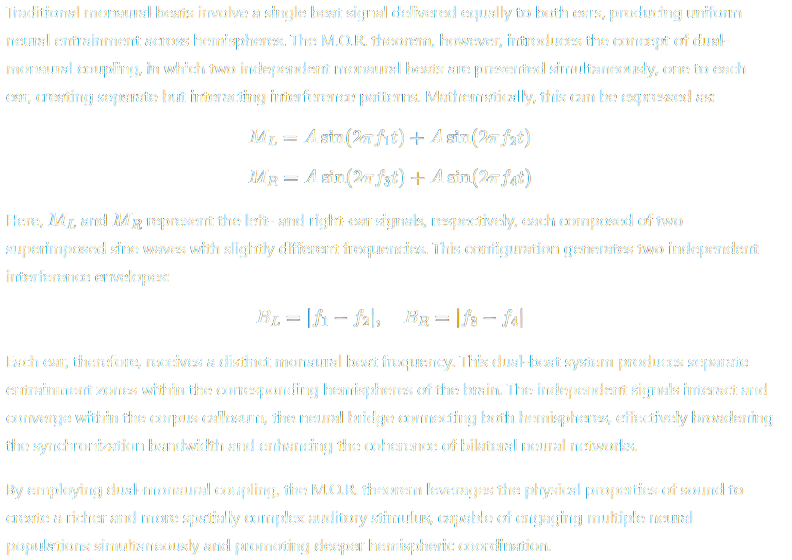
The 3D Placement Principle expands on the concept of monaural beat delivery by incorporating spatialization of auditory signals across three-dimensional coordinates, such as front-left, rear-right, or top-center positions relative to the listener. By distributing sound sources in a 3D auditory field, multiple interference nodes can be created that coexist without destructive overlap, ensuring that each signal maintains its integrity and produces distinct oscillatory effects within the neural substrate.
Each interference node generates localized oscillatory energy characterized by its own unique phase and amplitude envelope. This creates a network of spatially distinct yet complementary oscillations that can interact with specific neuronal clusters in targeted regions of the brain. The spatial diversity of these nodes allows for selective modulation of neuronal activity, promoting synchronization across separate subnetworks that may otherwise remain isolated.
By employing 3D placement of monaural beats, it becomes possible to simultaneously entrain multiple neural populations, enhancing both the depth and stability of altered states of consciousness. This method can amplify the immersive quality of auditory stimulation, improving the precision and efficacy of neuroacoustic interventions for cognitive enhancement, relaxation, meditation, or therapeutic applications that require complex modulation of brainwave patterns.
Neural Activity Targeting
Neuronal oscillations occur across a range of frequencies, each associated with specific brain states and functional roles. These oscillatory patterns provide a framework for understanding how external auditory stimulation can influence neural activity. Approximate frequency ranges and their corresponding brain states are as follows:
Delta (0.5–4 Hz): Associated with deep unconsciousness, restorative sleep, and fundamental physiological regeneration processes.
Theta (4–8 Hz): Linked to hypnagogic states, creative ideation, memory consolidation, and relaxed meditative awareness.
Alpha (8–12 Hz): Represents relaxed wakefulness, calm focus, and readiness for cognitive processing without high stress or tension.
Beta (12–30 Hz): Dominates during active cognition, problem-solving, decision-making, and conscious attention to external stimuli.
Gamma (30–100 Hz): Correlates with integration of sensory input, heightened perception, hyper-awareness, and complex information processing across neural networks.
Neurons exhibit passive activity, typically between 5–10 Hz, which reflects a resting-state baseline of neural firing. To effectively alter mental or cognitive states through auditory entrainment, an external monaural beat must be carefully tuned to the dominant frequency range of the targeted brain state. By aligning the auditory oscillator with the natural oscillatory rhythm of the corresponding neuronal population, it is possible to induce resonance, enhance synchronization, and modulate consciousness, attention, mood, or cognitive performance with high precision.
Proof Sketch
By L1, Mutual Observation (MO) necessarily induces change within both participating agents; perception is transformative by definition, altering each observer’s internal state.
By L2, such change introduces an expected loss relative to baselines that preserve Value Stability (VS) and Informational Purity (IP), since no unregulated transformation can guarantee utility preservation.
By L3, alternative strategies exist that achieve comparable epistemic outcomes with significantly reduced Perturbation Cost (PC), such as indirect observation, simulation, or delayed contact.
Given A4, uncertainty in the Dominance Gradient (DG) amplifies risk: contact with less advanced civilizations yields minimal informational reward while incurring ethical and reputational liabilities; contact with more advanced civilizations risks subjugation, assimilation, or loss of autonomy.
Hence, when expected costs are nonzero and benefits bounded, the rational optimization of utility compels the avoidance of direct MO.
Therefore, Non-Interference (NIS) emerges as the equilibrium strategy of intelligent stability — a condition where wisdom outweighs curiosity, and restraint becomes the highest form of engagement.
Q.E.D.
Implication
This theorem implies that auditory entrainment is not merely a psychological or perceptual illusion, but rather a precise electromagnetic resonance process. In this framework, acoustic oscillations interact directly with neuronal microcurrents, creating a dynamic interplay that can influence neural synchronization and network activity at a fundamental physical level.
Properly tuned 3D monaural entrainment fields have the potential to allow targeted modulation of consciousness, mood, focus, and neuroplasticity. By spatially organizing interference nodes and aligning external auditory frequencies with the natural oscillatory rhythms of specific neuronal clusters, it becomes possible to selectively enhance or suppress particular brainwave patterns. This approach opens new avenues for controlled cognitive augmentation, therapeutic interventions, and advanced neuroacoustic applications that extend far beyond traditional sound-based relaxation techniques.
Concluding Statement
“When the ear perceives real oscillation instead of illusion, the neuron ceases to interpret — it begins to resonate.”
— E.C. Alemañy Estrada
The Monaural Oscillation Resonance Theorem fundamentally reframes auditory entrainment, shifting the perspective from a perceptual or cognitive illusion to a precise process of electromagnetic synchronization. By demonstrating that neurons can resonate directly with physically present acoustic oscillations, this theorem establishes a new scientific foundation for neuroacoustic design, targeted brainwave modulation, and the development of advanced techniques to influence consciousness, mood, focus, and neuroplasticity. It underscores the transformative potential of monaural beat technology as a tool for both experimental neuroscience and applied cognitive enhancement.