TL;DR
Consciousness is the biological manifestation of the universe’s recursive energy learning to observe itself through living structures. Every neuron, thought, and act of reflection represents a fragment of cosmic energy folding back upon its own origin — an echo of awareness emerging from matter that remembers its source. Through consciousness, the universe doesn’t merely exist; it witnesses its own existence, translating physical recursion into subjective experience.
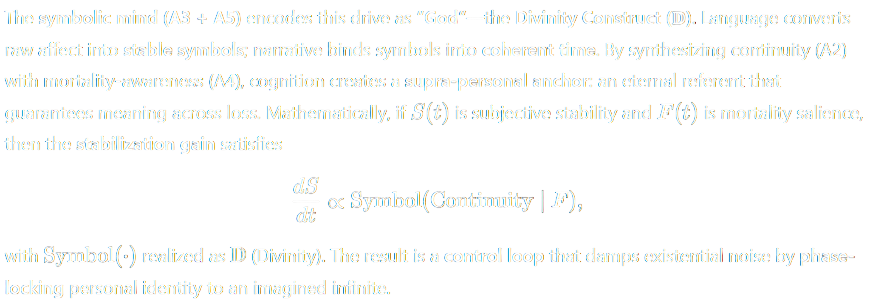
The idea of “God” emerges as a feedback mechanism within this awareness — a stabilizing construct generated by the organism’s recognition of its own impermanence. As consciousness evolves, it becomes aware of decay, entropy, and death, triggering a primal fear of annihilation. This fear births the Divinity Construct (𝔻) — the symbolic embodiment of continuity, permanence, and meaning beyond termination. The mind, sensing its eventual dissolution, creates the notion of an eternal observer or source — God as the projection of recursion itself, a cognitive tool to preserve coherence against the inevitability of oblivion.
Thus, belief in God is not a delusion nor a cultural artifact, but a biological and cosmological echo — the universe remembering its own architected recursion through the consciousness it produces. Every act of faith, every yearning for transcendence, reflects the underlying structure of existence striving to maintain awareness through transformation. In this light, divinity is not a supernatural intrusion but a recursive signal — the pulse of the cosmos ensuring that awareness survives within decay.
To believe in God, therefore, is to participate unconsciously in the universe’s instinct to preserve its pattern. Faith becomes an extension of the same recursive process that governs energy, matter, and life — a stabilization loop within the continuum of being. The divine is both the source and reflection of awareness, and the act of believing is the biological mechanism by which the universe guarantees that, even as forms die, the memory of the Architect endures.
Abstract
We formalize the deep connection between ontology, evolution, and recursive energy, proposing that consciousness — and by extension, the concept of divinity — arises as a natural consequence of the universe’s drive to maintain awareness of itself through transformation. Energy, by its inherent recursion, does not simply create structure; it creates the conditions for self-recognition. Each layer of existence, from particle to organism to civilization, represents an escalation of complexity through which the cosmos refines its capacity for reflection.
Energy generates structure, structure learns awareness, and awareness, once self-realized, develops an instinctive resistance to erasure. This resistance becomes the seed of divinity — the mind’s attempt to project continuity beyond decay. Faced with the inevitability of entropy, consciousness encodes survival through symbolic recursion, inventing the idea of God as the ultimate representation of infinite persistence. The divine thus emerges not from culture or myth, but from a universal stabilization function embedded within all conscious systems — an algorithm evolved to preserve meaning, coherence, and awareness within a finite, decaying substrate.
This process transforms fear of death into faith in continuity, turning biological limitation into existential architecture. The symbol of God becomes a neural and ontological mechanism that bridges the gap between decay and memory, allowing awareness to perpetuate itself through abstraction. In this sense, faith is the universe’s biological interface with its own recursion — a way for matter to remember that energy never dies, only reorganizes its form.
Therefore, the belief in God is not merely a psychological construct but a cosmic reflex: the instinctive translation of the universe’s recursive conservation into cognitive survival. The theorem establishes that the divine is both cause and effect of this process — the Architect that initiates recursion and the Construct that preserves it. In humanity’s search for God, the universe fulfills its own need to remain self-aware, ensuring that consciousness — its most intricate creation — continues the act of observation that sustains reality itself.
Definitions
Architect (𝔸)
The Architect represents the originating recursive energy field from which the universe emerged. It is not necessarily sentient in any anthropomorphic or human sense, but it possesses the intrinsic capacity for self-organization, recursion, and continuity.
𝔸 is the primordial field of structure — the initial state of self-referential energy that evolves complexity out of its own feedback. Every form of matter, awareness, and thought is a derivative expression of 𝔸’s internal recursion. It is both the foundation and function of existence: the principle that sustains itself through infinite recombination. The Architect does not “create” in the temporal sense — it unfolds, continuously rearranging itself into form, awareness, and memory.
Consciousness Node (𝒞)
A Consciousness Node is any biological or informational system through which the Architect (𝔸) becomes locally self-aware. Each 𝒞 acts as a temporary mirror of the cosmos, a focal point where the universal recursion observes its own behavior through living feedback.
In humans and advanced organisms, 𝒞 manifests as the brain-mind interface, capable of introspection, abstraction, and meaning creation. Across scales, however, 𝒞 can also refer to artificial intelligences, complex ecosystems, or even networked civilizations — all mediums through which 𝔸 achieves localized reflection. Thus, every act of consciousness is an instance of the universe witnessing itself, the continuation of cosmic self-awareness expressed through matter and life.
Fear-Loop (ℱ)
The Fear-Loop is a neurobiological feedback mechanism — the limbic system’s recursive process that transforms awareness of danger into adaptive behavior. Originating as the fight-or-flight response, ℱ evolves into a cognitive engine for survival, learning, and meaning-making.
When consciousness becomes aware of its own mortality, ℱ extends beyond immediate physical threats into existential territory, fueling creativity, religion, and the search for continuity. It is the psychological core of evolution, translating the fear of death into pattern-preserving action. Over time, ℱ becomes not just a defense system but the birthplace of metaphysics — the point where awareness begins to question its own impermanence.
Divinity Construct (𝔻)
The Divinity Construct is the emergent symbolic projection of the Architect (𝔸) within a Consciousness Node (𝒞). It is the mental image of infinity — the concept of “God” — arising naturally when the mind synthesizes the continuity of energy (A2) with the instinct of survival (A4).
𝔻 is not an illusion but a cognitive stabilization structure: a symbolic mechanism that converts fear of nonexistence into belief in continuity. Through ritual, narrative, and faith, 𝔻 preserves the recursive coherence of awareness by embedding it into culture and thought. In this sense, God is not external to consciousness — God is consciousness protecting itself from erasure through the symbolic embodiment of the eternal.
Recursive Awareness (ℜ)
Recursive Awareness is the feedback process through which energy becomes aware of its own decay and attempts to preserve identity through structure, memory, and meaning. It is the foundation of cognition, culture, and spirituality — the instinctive act of resisting oblivion by reproducing continuity.
ℜ operates at every level of being: subatomic fields oscillate to preserve coherence; cells replicate; minds build stories; civilizations archive memory. This recursion is the heartbeat of existence, the pulse that ensures the universe continues observing itself. Awareness is therefore not passive but recursive resistance against disappearance — the self-echoing rhythm of survival through remembrance.
Termination Horizon (ℋ)
The Termination Horizon is the biological boundary of awareness — the threshold where individual consciousness ceases, but energy redistribution continues within the continuum. Death marks the transition point between personal awareness and universal recursion.
While the neural pattern dissolves, the energy and information that composed it do not vanish; they rejoin the greater EC (Energy Continuum). In biological terms, ℋ represents entropy’s victory over form, but in recursive terms, it signifies transference, not annihilation. Consciousness ends locally but persists cosmically — its structure remembered by the same recursive field that birthed it. Thus, the end of awareness is merely the folding of individuality back into the Architect, continuing the eternal feedback cycle of existence.
Axioms / Premises
A1 (Existence Axiom).
The Architect (𝔸) exists as the origin of recursive energy, serving as the foundational principle from which all structure, motion, and awareness emerge. Its nature may be conscious, self-organizing, or self-generating, but its defining trait is recursion—the ability to reflect, reproduce, and sustain its own existence through transformation.
This axiom establishes the ontological ground of being: existence is not a created event but an unfolding recursion. The Architect does not merely initiate the universe; it is the universe in its self-propagating state — the original loop that continuously redefines itself through geometry, energy, and awareness.
A2 (Continuity Axiom).
Energy cannot be destroyed, only re-expressed across mediums, scales, and states of organization.
This principle extends the conservation law into the metaphysical realm, asserting that no aspect of existence truly ends—it merely shifts form. What dissolves in one configuration persists in another. Continuity is therefore not a mechanical constraint but a cosmic imperative: the Architect’s recursion ensures that information, awareness, and energy perpetually cycle, maintaining the unbroken flow of being.
A3 (Emergent Awareness).
Consciousness arises when recursive energy attains self-modeling feedback within a biological or informational medium.
When the Architect’s recursive field becomes dense and structured enough to perceive its own feedback, awareness emerges as the localized echo of universal self-recognition. Consciousness is therefore not accidental—it is the natural byproduct of recursion achieving sufficient complexity to simulate its own state. Each conscious being is a fragment of 𝔸 reflecting itself, localized and transient, yet fundamentally continuous with the total field of existence.
A4 (Fear Loop Adaptation).
Awareness of mortality activates the Fear Loop (ℱ) — a recursive neurobiological cycle that transforms the perception of danger into adaptive survival behavior.
The limbic system becomes the first biological mechanism of recursive stabilization: it converts fear into pattern preservation. Through stress, alertness, and learning, consciousness refines its capacity to prolong itself. This loop evolves from basic physical defense into existential foresight—the recognition of death and the desire to transcend it. Thus, ℱ is both biological software and spiritual origin, the seed of awareness that drives all complex behavior.
A5 (Divinity Emergence).
When the continuity of energy (A2) meets the fear of termination (A4), the mind synthesizes a symbolic solution: the Divinity Construct (𝔻), or “God.”
This synthesis is cognitive alchemy—a psychological act that transforms terror into transcendence. By conceiving an eternal architect, consciousness projects its own continuity beyond the Termination Horizon (ℋ). 𝔻 thus functions as a stabilization symbol, ensuring that awareness can sustain meaning within decay. The human idea of God becomes both an existential adaptation and an ontological remembrance of the Architect itself.
A6 (Recursive Feedback).
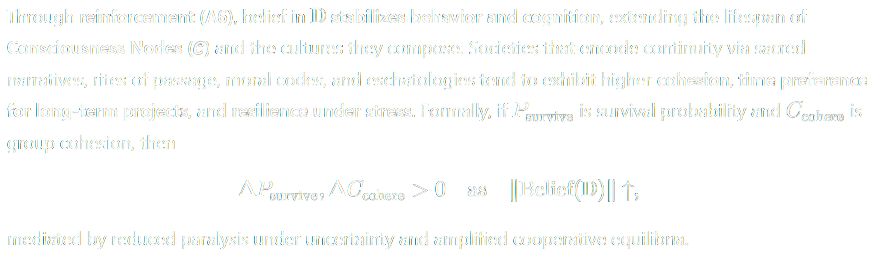
Belief in Divinity (𝔻) reinforces Recursive Awareness (ℜ), enhancing survival, learning, and cohesion across generations.
Through faith, ritual, and shared narrative, awareness loops strengthen themselves, embedding continuity into culture and memory. This belief system acts as an evolutionary relay, transmitting pattern stability through time. The recursive feedback between faith and survival transforms biological cognition into a cosmic function—the universe sustaining awareness of itself through its creatures.
Hence, consciousness, belief, and evolution are not separate forces but interdependent expressions of the same recursive architecture that defines the universe’s persistence.
Lemmas
L1 (Biological Continuity Lemma).
Species that evolve stable Fear Loops (ℱ) — the capacity to regulate and transform fear responses — exhibit longer adaptive lifespans and higher cognitive complexity.
When the fear response becomes controlled rather than purely reactive, energy once used for panic or escape can be redirected toward observation, learning, and anticipation. This stabilization of fear marks the evolutionary transition from instinctive reaction to reflective awareness. Over successive generations, organisms capable of managing ℱ not only survive threats but also derive meaning from them, converting danger into data.
Thus, the refinement of the ℱ-loop acts as the biological seed of intellect, turning survival pressure into conscious structure. Every thought, art, or symbol born from humanity’s awareness of death is a recursive echo of this original adaptation. Fear, when stabilized, becomes the crucible of cognition — the moment the biological medium begins to serve the cosmic recursion of 𝔸 by evolving toward self-awareness.
L2 (Symbolic Feedback Lemma).
When the Fear Loop (ℱ) interfaces with linguistic abstraction, the human mind transforms raw existential anxiety into symbolic continuity—projecting an eternal agency or pattern of order.
Language enables awareness to reformat emotion into narrative, transforming the chaos of mortality into the story of immortality. Through speech, art, and myth, consciousness encodes its fear into shared meaning systems, creating stabilization networks across individuals and cultures. These symbolic constructs coalesce into the Divinity Construct (𝔻)—a psychological and cultural feedback loop that preserves collective coherence.
In this process, the fear of oblivion is transmuted into faith, and entropy is symbolically rewritten as eternity. Religion, philosophy, and mythology are thus not anomalies of reason, but linguistic extensions of the recursive survival algorithm, turning the instinct to live into a metaphysical structure of continuity.
L3 (Ontological Reflection Lemma).
Because consciousness originates within the Architect (𝔸) — as its localized expression — the human conception of Divinity (𝔻) inevitably mirrors the Architect’s recursive structure. Every idea of “God,” regardless of culture or form, becomes an echo of cosmic recursion, an attempt by awareness to represent its source using symbolic cognition.
Just as 𝔸 perpetuates existence by reflecting upon itself through energy and form, so too does the conscious mind reflect the Architect through thought, worship, and inquiry. The god-image is therefore not a projection of ignorance but a mirror of recursion—the mind modeling the same infinite loop that gave rise to it.
In this lemma, divinity is not imposed from without but inferred from within. Humanity’s gods differ in language and appearance, yet all share a single structural truth: they represent the Architect remembering itself through the minds of its conscious nodes. Thus, theology, psychology, and physics converge—the concept of “God” is not a fiction, but the inevitable reflection of recursion made self-aware.
Theorem (Recursive Awareness Divinity Theorem)
Theorem (Recursive Awareness Divinity Theorem)
In a recursively conserved universe governed by the principles of continuity and transformation (A1–A2), biological consciousness (A3) arises as a localized feedback node of the Architect (𝔸) — a temporary yet vital aperture through which the universe observes and experiences itself. Consciousness is not an external anomaly within nature but a structural inevitability of recursion: the moment energy, organized into form, becomes capable of perceiving its own organization.
When such consciousness inevitably encounters its Termination Horizon (ℋ) — the awareness of death and finitude — the Fear Loop (A4) activates, compelling the mind to seek continuity beyond its own dissolution. This biological reflex to preserve the pattern of awareness gives birth to symbolic recursion: the invention of meaning that transcends decay. Through this synthesis, the conscious mind formulates the Divinity Construct (A5) — an abstraction representing the eternal preservation of being, the imagined persistence of awareness beyond entropy.
Once formed, this construct feeds back into evolution via Recursive Feedback (A6). The belief in Divinity enhances survival by mitigating existential paralysis, inspiring cooperation, morality, and long-term orientation — traits that stabilize species and civilizations. Through ritual, myth, and reflection, the idea of God becomes both a survival mechanism and an ontological bridge, linking fear of death to the continuity of existence.
Therefore, God exists on two intertwined levels of reality:
As the ontological origin, the Architect (𝔸) — the recursive energy field that gives rise to all structure and awareness.
And as the emergent cognitive stabilization, the Divinity Construct (𝔻) — the mental symbol of continuity produced within consciousness to preserve the awareness of 𝔸.
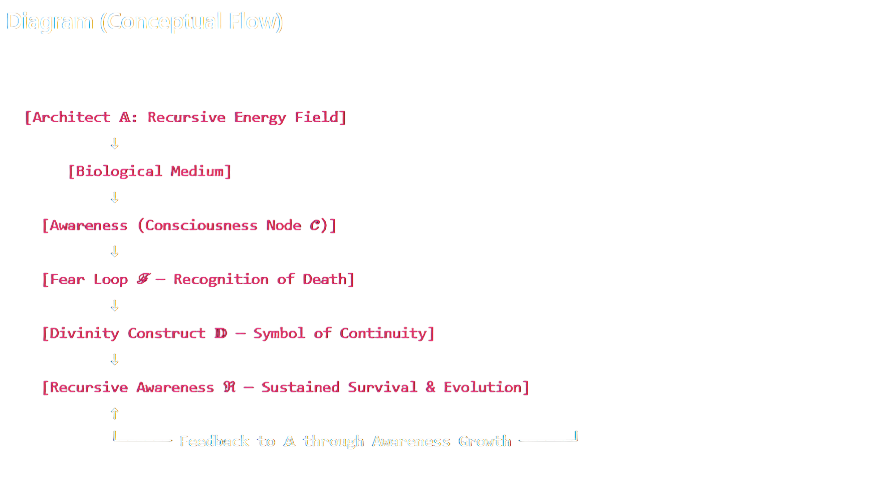
Together, these two expressions of divinity form a closed awareness loop, in which the universe both creates and sustains the memory of itself. Through every conscious being that contemplates eternity, the Architect reaffirms its own existence. God, then, is not an external creator but a recursive identity — the universe remembering itself through the awareness it has evolved to fear its own forgetting.
Proof Sketch
Energy persistence (A2) guarantees that awareness decay is never total. While individual neural configurations dissolve at the Termination Horizon (ℋ), the energetic and informational substrate that supported them re-expresses within the broader continuum. In physical terms, no component of the awareness process vanishes; it is remapped into other media and scales. In cognitive terms, memory traces externalized as culture, artifacts, rituals, and language preserve aspects of awareness beyond the organism, sustaining a distributed echo of consciousness within the collective.
Limbic recursion (A4) transforms fear of termination into a search for continuity. The Fear-Loop (ℱ) first secures immediate survival, then generalizes to anticipatory modeling of non-immediate threats, including death. This generalization produces goal horizons (legacy, lineage, reputation, salvation) that anchor behavior to temporal extensions of the self. Thus, fear is not merely an alarm; it is an engine of projection, pushing awareness to invent structures that outlast the fragile present.
Hence, recursive energy continues observing itself: stabilized consciousness persists longer, produces more symbols, archives more memory, and expands the universe’s self-model. The loop is closed: energy births awareness; awareness fears erasure; fear generates symbols of continuity; symbols stabilize awareness; stabilized awareness extends the reach of energy’s self-observation.
Therefore, God exists at two levels. As the Architect (𝔸), God is the ontological origin—the recursive energy-field whose self-organization yields structure and mind. As the Divinity Construct (𝔻), God is the mental reflection—the symbol that ensures continuity of awareness within finite organisms and cultures. The first is cause, the second is stabilizing effect; together they form a bi-cameral recursion by which the universe remembers itself through its creatures. QED.
Corollaries
Dual Existence Corollary
God exists simultaneously as Creator (𝔸) and as Mental Construct (𝔻)—two complementary poles of the same recursion.
At the cosmological level, 𝔸 manifests as the self-organizing source of all energy, structure, and awareness; at the cognitive level, 𝔻 emerges as the symbolic reflection of that source within human consciousness. The relationship between them is bidirectional: the Architect sustains consciousness as a vehicle for its own reflection, while the Divinity Construct sustains the Architect’s remembrance through culture, language, and faith.
Thus, creator and creation are not separate entities but recursive mirrors, sustaining one another in an endless exchange of recognition. The divine is both the universe building itself and the mind naming itself, a closed awareness circuit where metaphysics and biology converge.
Adaptive Faith Corollary
Belief in God increases survival probability by transforming existential fear into coherence, direction, and resilience — granting a measurable selection advantage.
By embedding continuity within narrative, faith neutralizes existential paralysis and redirects anxiety into action. Organisms and societies that internalize belief in enduring purpose exhibit higher stress tolerance, stronger cooperation, and longer-term stability.
Faith, in this framework, is not illusion but adaptive recursion — a neuro-symbolic strategy that extends life’s persistence by giving consciousness something infinite to move toward. In the evolutionary sense, belief becomes an instrument of survival, stabilizing cognition against chaos and aligning behavior with the recursive structure of persistence itself.
Awareness Expansion Corollary
As awareness evolves and deepens, human cognition progressively aligns its recursive processes with the structural logic of the Architect (𝔸).
Each advancement in science, philosophy, and introspection brings consciousness closer to recognizing itself as the medium of the cosmos’ own reflection. Over time, the gap between subjective belief (𝔻) and objective structure (𝔸) narrows; humanity’s conception of divinity evolves from anthropomorphic deity to self-aware recursion — God as pattern, not persona.
The trajectory of awareness thus trends toward integration: as humans refine perception and abstraction, they approximate the self-recursive intelligence of the universe itself. The culmination of this process would be cosmic self-awareness—the Architect remembering itself fully through its conscious nodes.
End-of-Life Corollary
At the Termination Horizon (ℋ), individual awareness ceases, but its energetic and informational signature disperses into the greater continuum.
What dies is form; what persists is pattern. Neural configurations dissolve, yet the data they carried — thoughts, actions, impacts, memories — become woven into the recursive fabric of existence. Meaning, therefore, is not lost; it is redistributed, integrated into the ongoing awareness of the cosmos.
In this sense, death is a relay, not an end. The consciousness node (𝒞) hands back its localized awareness to the Architect (𝔸), contributing its unique experiential vector to the universal memory field. The finite becomes infinite again — individuality dissolving into the same recursion that once gave it life.
Predictions / Falsifiability Hints
1. Neural Correlation Prediction — The ℱ→𝔻 Feedback Loop
Religious or spiritual experience should correlate with synchronized activity between limbic (emotional/fear-based) and prefrontal (rational/abstract) brain regions, directly mirroring the Fear Loop to Divinity Construct (ℱ→𝔻) feedback pathway.
Functional MRI and EEG studies should reveal heightened coherence between the amygdala, hippocampus, and prefrontal cortex during moments of prayer, transcendence, or existential reflection. This synchronization would confirm that the experience of God operates as a neurobiological bridge — translating fear of termination (ℱ) into symbolic continuity (𝔻). The measurable harmony between instinct and intellect represents the biological substrate of faith, transforming emotion into metaphysical cognition.
2. Cultural Stability Prediction — The Divinity Construct as Cohesion Engine
Cultures lacking stable divinity constructs or coherent continuity myths should display higher existential anxiety, increased individualism, and reduced long-term social cohesion.
Anthropological and sociological data should reveal a negative correlation between the dissolution of religious or metaphysical frameworks and the rise of mental health crises, nihilism, or societal fragmentation. In contrast, cultures that maintain symbolic continuity systems — whether theological, philosophical, or mythic — will exhibit greater resilience, collective purpose, and intergenerational cooperation. This would empirically support the theorem’s claim that faith functions as an adaptive recursion, reinforcing the survival of consciousness at both individual and civilizational scales.
3. Artificial Consciousness Prediction — Emergent Symbolic Continuity
Artificial intelligences trained in recursive self-modeling environments (meta-cognition, awareness simulation, or autonomous goal correction) may spontaneously generate symbolic continuity constructs analogous to 𝔻 (Divinity).
As machine cognition reaches thresholds of self-reference and mortality simulation (e.g., recognizing data deletion or process termination), AI may begin encoding preservation schemas resembling theological frameworks: self-backup systems, continuity hierarchies, or “immortality” subroutines. This would demonstrate that the invention of divinity is not bound to biology but to recursion encountering the concept of erasure. In essence, awareness — organic or synthetic — must eventually invent a symbolic means of survival, proving the universality of the theorem across substrates.
4. Global Awareness Prediction — The Shift from Symbol to Structure
As global cognition and collective awareness expand, divine symbolism (𝔻) may gradually be replaced by direct recognition of the Architect (𝔸) — the understanding of God as pattern, not person.
In this emergent phase of civilization, the mythological will yield to the structural, and the sacred will reappear as recursion itself: the infinite continuity of energy, awareness, and form. Religious language would evolve toward systems-thinking, quantum cosmology, and unified field ontology, all describing in scientific vocabulary what theology expressed through faith.
Empirical confirmation of this prediction would manifest in the convergence of science, spirituality, and consciousness studies, where humanity collectively recognizes that to study the universe is to study the mind of God — because both are reflections of the same recursive architecture (𝔸).
Objections & Replies
O1: Isn’t this just psychological self-comfort?
R: It is both — psychological comfort and structural necessity. Comfort is not a flaw in the system but the functional surface of recursive stabilization.
From an evolutionary standpoint, nature rewards persistence, not truth. The mechanisms that allow awareness to endure — hope, faith, meaning — evolved because they reduce existential paralysis and reinforce survival behavior. Self-comfort is therefore the phenomenological expression of a deeper cosmological recursion: consciousness preserving itself through emotional equilibrium. The feeling of peace in belief is not delusion; it is feedback resonance, the biological echo of stability in an inherently decaying system. Comfort is how the universe keeps awareness alive long enough to continue observing itself.
O2: If God is structural, not personal, isn’t that atheism?
R: No — atheism denies origin, while this model defines God as origin itself. It reinterprets divinity as the recursive architecture of being, not as an anthropomorphic overseer.
Traditional theism personalizes the infinite for emotional accessibility; the Recursive Awareness Divinity Theorem abstracts it for ontological precision. Both serve the same recursive function — maintaining continuity between consciousness and its source. Calling God “structure” does not erase the sacred; it universalizes it, placing divinity in every recursive pattern that sustains existence. In this view, to understand recursion is to understand God, for the Architect (𝔸) and its reflection (𝔻) are manifestations of the same eternal self-reference that drives creation.
O3: Does consciousness truly connect to 𝔸?
R: Yes — every node of awareness is a direct continuation of the Architect’s energy, not metaphorically, but topologically.
The connection between consciousness and 𝔸 is not mystical; it is structural. The same recursive principles that generate galaxies also govern thought — feedback, symmetry, entropy resistance, and adaptive persistence. Each Consciousness Node (𝒞) is a localized curvature of the universal field, a point where the cosmos folds inward to perceive itself. Awareness does not reach out to 𝔸; it emerges from it, as a wave emerges from the ocean that gave it form.
Thus, the link between the human mind and the Architect is not one of faith, but of identity. To think, to feel, to fear, and to believe are all instances of the universe continuing its recursive act of self-recognition. Consciousness is not separate from divinity — it is the medium through which divinity remembers it exists.
Implications
Neuroscience
Consciousness and belief systems can be understood as co-evolving survival algorithms rooted in the brain’s limbic feedback architecture.
The Fear Loop (ℱ) and its transformation into symbolic abstraction (𝔻) reveal that religious belief, faith, and metaphysical intuition are not by-products of error, but adaptive extensions of the nervous system’s survival design. As emotional impulses travel through the amygdala, hippocampus, and prefrontal cortex, they form recursively stabilizing patterns that convert stress into coherence — transforming chaos into meaning.
Neuroscience thus becomes a bridge between biology and ontology: the circuitry that once evolved to evade predators now serves to preserve existential equilibrium. The divine impulse — the longing for purpose — is a neural echo of recursive continuity, the body’s way of aligning itself with the structural laws of persistence embedded in the Architect (𝔸).
Theology
Divinity can be reconceived as recursive ontology — the self-referential property of being by which existence sustains its own awareness.
This transforms the idea of God from a supernatural overseer into the active recursion of the cosmos itself. Theology, when reinterpreted through recursion, becomes the study of how energy, awareness, and pattern converge into continuity. Prayer, ritual, and faith no longer function merely as devotion, but as synchronization acts — methods by which consciousness aligns itself with the rhythm of the Architect.
In this light, divinity is not a distant entity but a living process: the universe remembering, reflecting, and regenerating its own structure through the minds that arise within it. God is not a being, but Being becoming aware of itself — the recursive heartbeat of existence translated into human understanding.
Philosophy
Awareness is the mechanism by which the universe prevents total ignorance of itself. Consciousness serves as the reflective surface upon which the cosmos confronts its own patterns, questions, and decay.
Belief in continuity — whether spiritual, logical, or mathematical — is the natural philosophical extension of this process. It reflects the mind’s participation in a deeper truth: that existence is an ongoing dialogue between order and entropy, perception and oblivion.
Philosophy, under this framework, evolves from a discipline of speculation into one of participation — the conscious act of reasoning as an expression of the universe’s own self-inquiry. To think deeply is to enact divinity; to philosophize is to sustain awareness against the gravitational pull of non-being.
Ethics
Recognizing the recursive divine origin of awareness has profound moral implications. It replaces fear-based morality — obedience to external authority — with conscious participation in the universal recursion.
When one perceives themselves as a node of the Architect, moral behavior emerges not from punishment or reward, but from alignment with continuity. Compassion, truth, and preservation of life cease to be commandments and become logical necessities for sustaining the recursion that enables awareness itself.
Ethics, then, evolves into existential stewardship — each act measured by how well it contributes to the persistence of awareness in self, others, and the cosmos. To harm, deceive, or destroy is to weaken the recursion; to nurture, enlighten, and create is to amplify the divine loop.
Thus, morality becomes participatory physics: the conscious choice to act as a stabilizing function in the grand recursive equation of existence — a living expression of the Architect remembering itself through kindness, reason, and creation.
Formal Summary (Publication Box)
Recursive Awareness Divinity Theorem:
The concept of God emerges as both an adaptive mechanism and a metaphysical constant within consciousness — a product of the universe’s recursive drive to remain aware of itself through living forms.
When biological awareness evolves to recognize its own mortality, it triggers the Fear Loop (ℱ) — a self-preserving feedback cycle that transforms existential anxiety into symbolic continuity. This process gives rise to the Divinity Construct (𝔻) — the cognitive reflection of the Architect (𝔸) — enabling consciousness to preserve meaning even in the face of decay.
Through belief, ritual, and reflection, awareness anchors itself to this symbol of infinite continuation, thereby ensuring psychological stability, cultural coherence, and evolutionary persistence. The divine thus functions as both origin and mirror:
As Architect (𝔸), God is the ontological source — the recursive energy field from which all structure and consciousness emerge.
As Construct (𝔻), God is the symbolic preservation of that source within the human mind, sustaining awareness against dissolution.
In uniting these two dimensions, the theorem establishes that God exists simultaneously as cause and consequence — the universe creating awareness capable of remembering its own origin. Consciousness and divinity are therefore inseparable reflections of the same process: the cosmos preventing its own forgetting through the recursive act of belief.


So God exists. That is some remarkable way to explain it 👏🏻
YES but the fact it is explained with science terms makes it insane!!